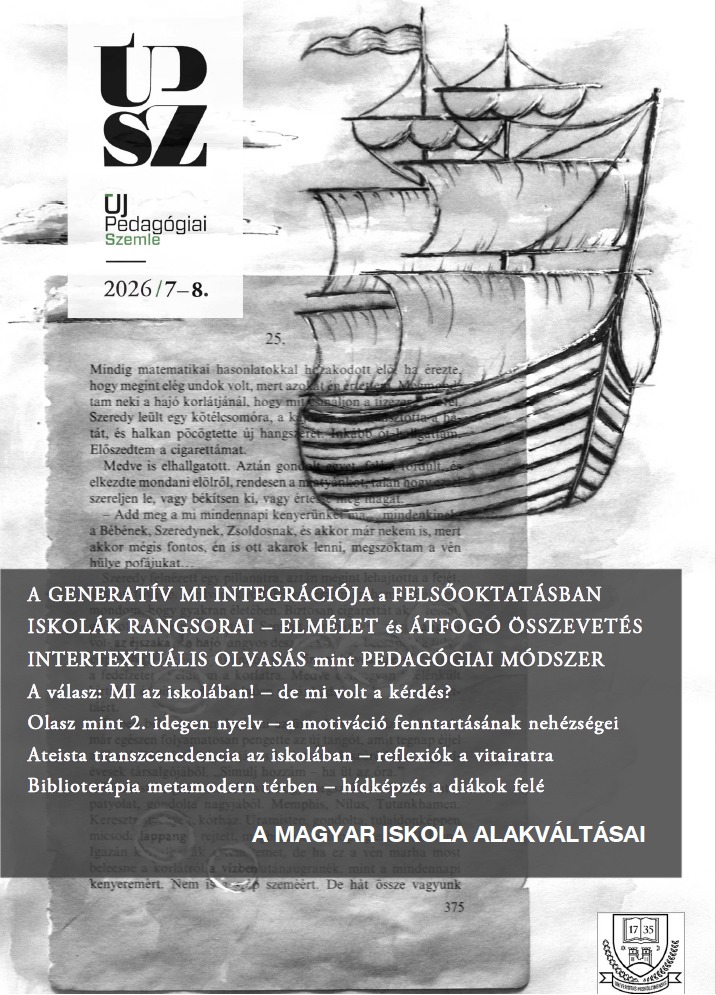
Vol. 76
(2026)
Issue 07-08 | DATE OF PUBLISHING: 2026-09-14 ABSTRACTS | 5-8 | TRENCSÉNYI, LÁSZLÓ We can speak of a school structure, spaces and functions similar to those of today as early as the 17th and 18th centuries. During this period the student way of life became a universally accepted system of norms. Here we traces the history of the institutional ethos of schooling — with a focus on Hungary — from the factors that triggered the change up to the present day. Despite the many doubts that have arisen in the meantime, this ethos has been rebuilt again and again on very similar foundations, while also continually generating alternatives. |
| 9-25 | T. NAGY, JUDIT – DRJENOVSZKY, ZSÓFIA – KOVÁCSNÉ HEGEDŰS, DÓRA – ALBERT, ORSOLYA – DRINGÓ-HORVÁTH, IDA The aim of this study is to qualitatively explore the experiences and practical applications of generative AI among Hungarian higher education teachers. The empirical data collection was conducted between May and September 2024 through semi-structured interviews with 32 university teachers. The sample represents 13 domestic institutions and 7 fields of study, ensuring the disciplinary diversity of the study.
The results identified five main functional areas where AI has been organically integrated into teaching workflows: (1) development and personalization of educational materials, (2) classroom integration and critical resource management, (3) support for foreign language publication activities, (4) literature research, and (5) creative inspiration and professional self-monitoring. The analysis highlights that educators primarily view technology as a “digital assistant”, emphasizing its time-saving and efficiency-enhancing role, while maintaining the primacy of professional control and human expertise. The study concludes that, in addition to technological integration, structured institutional regulation and the development of faculty AI literacy are essential, enabling actors to use algorithm-based systems consciously and ethically.
|
| 26-66 | BÉRES, ANDRÁS This study compares the 2025 and 2026 Hungarian grammar school rankings published by HVG and jointly produced by Mathias Corvinus Collegium and the Hungarian Educational Authority (MCC–OH). It examines the extent to which the two rankings, which draw partly on shared data sources but use different indicator sets and aggregation logics, identify the same leading institutions and the indicator profiles associated with Top 10 positions. Institutional overlap at the Top 10, Top 20, Top 50 and Top 100 levels is assessed using counts, overlap rates and the Jaccard index, while the ordering of institutions appearing in both Top 100 lists is examined through Spearman’s and Kendall’s rank correlations. The internal structure of the Top 10 groups is analysed using mean indicator ranks and rank-based standardised institutional profiles visualised as heatmaps. The findings show substantial but incomplete convergence in the broader Top 100, whereas Top 10 membership and individual rank positions are more sensitive to the methodology applied. Both rankings include relatively balanced profiles that perform favourably across several dimensions, but specialisation–compensation patterns are also present. The study concludes that rankings are not complete or neutral measures of school quality: their differences reveal how alternative indicator choices and aggregation decisions make different dimensions of grammar school performance visible. |
| 67-87 | KÁNTOR, PÉTER How do we understand literary works? How do we construct the meaning of texts as we read? This study seeks to answer the question of how the process of understanding literary texts can be shaped through a methodological renewal of high school literature instruction.
Its theoretical starting point is Bakhtin’s fundamental principle that texts are not isolated units but depend on other texts and are interconnected within a network of cultural references; consequently, their meaning arises from their juxtaposition with one another. The concept of intertextuality—coined by Julia Kristeva and still widely used and studied today—also reflects this phenomenon.
Drawing on findings from reading research, this study assesses the challenges of teaching literature and argues that intertextuality, as a reading strategy, can help us address these challenges. Through several practical examples, the paper demonstrates that intertextuality is not merely a concept in literary theory or linguistics, but also an effective pedagogical tool. In high school literature classes, it is worthwhile to consciously emphasize that texts should not only be examined in isolation but also “read in relation to one another” by juxtaposing them according to various criteria.
|
| 88-101 | POLÓNYI, ISTVÁN This study examines the role of artificial intelligence in education from a critical perspective, arguing that it does not necessarily constitute a paradigm shift but should rather be understood as another layer in the historical evolution of educational technology. Through a historical overview, it shows that waves of technological innovation in education have consistently been accompanied by excessive expectations, while empirical evidence has failed to confirm substantial improvements in educational effectiveness. Based on recent international research, the use of AI in education appears primarily complementary: teachers mainly employ it for administrative and preparatory tasks, while students use it for information retrieval and text processing, often to simplify learning processes. Using the framework of Baumol’s cost disease, the study analyzes the structural constraints on productivity in education and concludes that AI is unlikely to overcome these limitations. It also addresses issues such as growing inequality, the deepening digital divide, and broader societal risks associated with AI applications. Regarding labor market effects, the paper adopts a skeptical stance grounded in historical experience, challenging technologically deterministic views. Overall, the analysis concludes that the impact of AI on education largely depends on its social and pedagogical context and is unlikely, in itself, to transform the fundamental nature of education.
|
| 102-109 | SZABÓ, NIKOLETT The study provides a literature review examining the social role of language learning, the educational policy context, the European Union’s objectives regarding multilingualism, and the specific characteristics of foreign language education in Hungary, with particular attention to the situation of Italian as a second foreign language in Hungary and students’ language learning motivation. Italian is a popular choice among the compulsory second foreign languages offered at many upper secondary schools; however, research shows a steady decline in the initial enthusiasm for the language and a decrease in the effectiveness of language learning. To explore possible reasons for this pehnomenon, the study examines the role of integrative and instrumental motivation, as well as common motivational problems and the use of inappropriate learning strategies that arise during the learning of a second foreign language, emphasizing the importance of exploring possible ways to address these issues. |
| 110-112 | NAGY, ÁDÁM Gábor Németh’s essay, titled “The Absence or Transformation of Transcendence? An Interpretation of Atheistic Transcendence from a Christian Pedagogical Perspective,” places an anthropological problem in education at the center of its discussion. The author attempts to interpret the moral commitment and community cohesion manifested in secular pedagogical spaces as a form of transcendence. The central pedagogical claim of the ideas developed in the above study is that transcendence is not the exclusive domain of religious people, but rather a universal anthropological trait that is also present in secular educational settings. The purpose of this reflection is to examine the propositions put forward in the study from a humanistic perspective, with the main argument being that the author is making a mistake when he characterizes thinking that goes beyond the self—and, in some cases, communal thinking—as transcendence. |
| 113-117 | GLOVICZKI, ZOLTÁN The article continues the line of thought of Gábor Németh's essay published in Új Pedagógiai Szemle 2026/5-6. on the presence of transcendence in contemporary pedagogical thinking. It sheds light on the fact that the search for transcendence is not a characteristic of modern Christian religion, but is inherent in the spiritual development of man, so its presence in contemporary atheistic thinking is a natural phenomenon. It also highlights that the discussion of transcendence is not explicitly an organizing element of Christian (Catholic) education, so it is not justified to emphasize the believer-atheist fault line when discussing the issue. |
| 118-134 | RAJNAI, LÁSZLÓ The study examines the cognitive divide in public education, which emerges between the objectivist, tradition-mediating logic of the modern pedagogical institutional system (the Habermasian System) and the postmodern, fragmented Lifeworld of adolescents. The educational-philosophical analysis outlines a metamodern pedagogical framework that may be capable of bridging this cultural and epistemological gap without taking an exclusive stance on either of the examined paradigms.
The theoretical foundation of the research is provided by the central concept of metamodernism, the continuous oscillation between the endpoints of modernism and postmodernism. For this, the study turns to Biller’s Bildung model: during personality development, students progress from states of being-for-oneself toward states of existence in an adaptive relationship with the world. The central assertion of the study is that the methodology of developmental bibliotherapy may be suitable for creating a mediating, metamodern pedagogical space. Participating students become capable of holding contradictory narratives in their consciousness simultaneously, and reflect on these within a safe, transitional pedagogical space. Thus, the practice of developmental bibliotherapy does not eliminate the tension between modern normativity and postmodern relativism; rather, by integrating it, it supports identity construction and assists students in their autonomous, reflective virtual home-making in the world.
|
| |