Vol. 76
(2026)
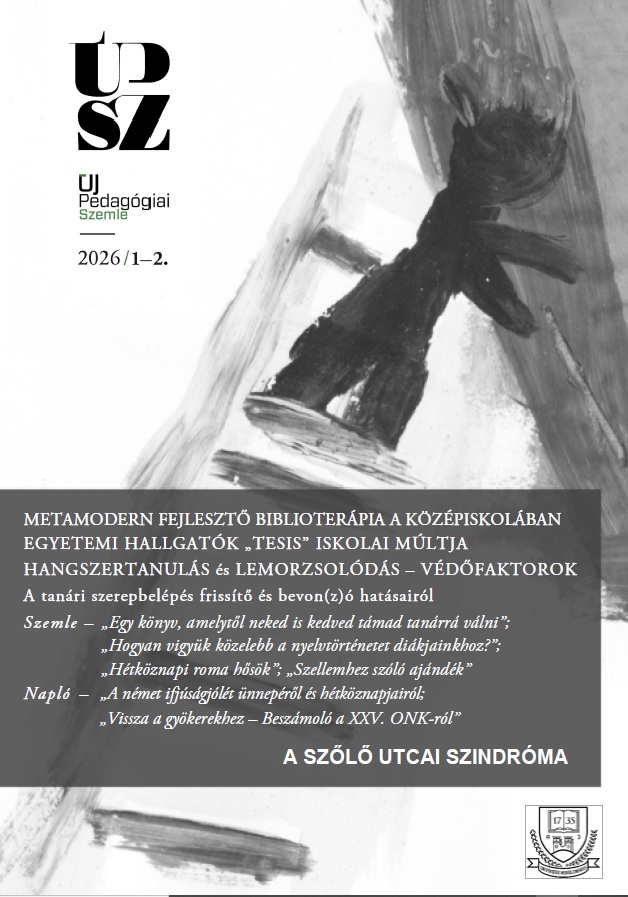
Issue 01-02 | DATE OF PUBLISHING: 2026-03-17 ABSTRACTS | 5-10 | TAKÁCS, GÉZA The article aims to demonstrate that the atrocities that took place in the Szőlő Street Reformatory over the past decade—as well as how all this came to light and what happened thereafter to the institution and the young people placed there—is a case in the Hungarian educational and social sector, that has in fact occured elsewhere as well, in the past and in the present. Because the system has been struggling with serious problems for decades, which the public only occasionally learns about. After all, there are serious obstacles and risks to narration and discussion. The author formulates his criticism by recalling his own, personal, never-spoken experiences from his pedagogical career. From the case that became a political scandal, he reads a painful chapter of social, professional, and community history and an urgent lesson in self-knowledge.
|
| 11-40 | RAJNAI, LÁSZLÓ The study analyzes the theoretical foundations and practical application of developmental bibliotherapy within the framework of secondary school foreign language education. This approach is necessitated by legal requirements for educators to support students’ personality development and mental health protection alongside academic instruction—a function for which developmental bibliotherapy serves as a suitable instrument. The specific hybrid environment of foreign language classes, characterized by high contact hours and thematic flexibility, provides a favorable setting for personality-development activities. The use of a foreign language induces an emotional buffer effect, which facilitates the secure management of ego-proximal content and promotes deeper self-reflection.
The methodological framework is based on Content and Language Integrated Learning (CLIL) and the 4C model (Content, Cognition, Communication, Culture), allowing for the simultaneous realization of linguistic and socio-emotional objectives. The study analyzes the correlation between language proficiency levels (CEFR) and the efficacy of bibliotherapy. It recommends the Socratic dialogue method for analyzing literary works and demonstrates, through concrete practical examples, how students can become active agents of their own narratives through text interaction.
|
| 41-57 | HORVÁTH, CINTIA The changing needs of young people and the evolving social environment pose new challenges for physical education. In addition to traditional teacher-centered methods, there is a growing need for student-centered, experience-based approaches that enhance students’ active participation, motivation, and health awareness. The aim of our study was to explore what kind of secondary school physical education experiences first-year students at Eszterházy Károly Catholic University bring with them to higher education, with particular focus on their sports background, lesson content, and exposure to student-centered methods. A total of 78 students participated in the online questionnaire survey (33.3% male, 66.7% female). Of the respondents, 79.5% graduated from grammar schools, and 14.1% had a physical education specialization. More than half had trained regularly as licensed athletes during their secondary school years, and currently two-thirds engage in some form of sport, although one in five students is inactive. The most frequent activities in PE lessons were ball games, gymnastics, and athletics, while swimming, combat sports, and winter sports appeared only rarely. The application of student-centered methods was low: nearly 80% of the students had never completed a project task, and only 58% reported encountering task cards or peer assessment. Our findings indicate that although the introduction of daily PE increased the amount of physical activity, methodological innovation has not yet become widely integrated into secondary school practice. Further phases of this longitudinal study may reveal how the gradual inclusion of modern pedagogical tools influences young adults’ sporting habits, motivation, and health-conscious lifestyles.
|
| 58-76 | SZABÓ, NORBERT – FÖLDI, FANNI – JÓZSA, KRISZTIÁN Sustaining students’ motivation is a key condition of successful and persistent instrumental music learning. Grounded in Self-Determination Theory (SDT), this study explores how the satisfaction and frustration of autonomy, competence, and relatedness needs are reflected in everyday experiences of instrumental learning. We conducted semi-structured interviews with instrumental students (n=7; aged 12–19) and parents (n=7). A theory-driven thematic analysis indicated that autonomy-supportive opportunities (e.g., shared decisions about instrument choice, repertoire, and learning goals) strengthen engagement; competence is reinforced by constructive feedback, appropriately challenging tasks, and making progress visible; and relatedness is supported by high-quality teacher-student-parent communication, shared performance experiences, and peer recognition. In contrast, controlling parental pressure, inflexible teaching practices, time overload, and peer devaluation may increase the risk of motivational decline and dropout. The findings provide practice-oriented guidance for teachers and parents on how to create a motivation-supportive learning environment in instrumental music education.
|
| 77-93 | BETHLENFALVY, ÁDÁM – TÓTH-CSIKI, ZSUZSANNA This study explores the pedagogical use of Teacher-in-Role as a key method in drama education that may enhance student engagement and foster more democratic classroom interactions. The research investigates how a teacher’s participation in a fictional role reshapes learning relationships, student motivation, and classroom power structures.
A mixed-method design was applied. In 2025, quantitative data were collected through standardized questionnaires completed by 122 students. Qualitative data were provided by teachers’ reflective journals and focus group discussions. Findings indicate that most students experienced lessons involving teacher-in-role as enjoyable and exciting, and a significant proportion would recommend its use in other subjects.
Qualitative reflections highlight both the strong motivational potential of the method and its challenges: teacher-in-role requires careful framing, sensitivity to group dynamics, and a high level of teacher reflexivity to maintain emotional safety and learning focus.
Overall, teacher-in-role emerges as a powerful experiential practice that can make school learning more meaningful, participatory, and connected to students’ lived experiences. |
| 94-95 | ALPÁR, VERA The review primarily shares the professional reader's experience of the book in question, praising how the volume „brings with it forty years of experience,” and naturally presents educational institutions—which often do not function in this way—as possible spaces for learning that connect with each other and the world in its narratives. The reviewer naturally extends his personal insights to the context of professional enthusiasm that can be experienced by everyone. |
| 96-103 | BODNÁR, ILDIKÓ The reviewer presents a revised an expanded „version” of László Grétsy's book on lexical/semantic split, detailing numerous examples from linguistic history and their possible literary appearances, thereby demonstrating the book's great usefulness in schools. |
| 104-106 | FORRAY R., KATALIN The book in question provides an analysis of the Amrita Association's inclusive career orientation program for young Roma people, which also provided residential accommodation (1995–1999). The reviewer reviews the chapters of the volume and describes the work as an inspiring document that presents important new information, including previously unpublished interviews. |
| 107-112 | FÖLDES, PETRA – VESZPRÉMI, ATTILA On this occasion, the two reviewers are, exceptionally, the two editors of ÚPSz, and the volume was published on the occasion of the 70th birthday of the editor-in-chief of the journal. The reviewers briefly summarize the studies included in the volume, which together paint a colorful picture of current thinking in certain segments of educational science. |
| 113-129 | TÓBIÁS, LÁSZLÓ The author has been participating in study visits for decades. From his experience obtained at the German Child and Youth Welfare Congress, he presents what he finds the most relevant for Hungarian experts, sketching also the system of German youth welfare as a background. The goal of the paper is to supply the reader with plenty of online references to start off to get to know the German youth welfare system. It is especially advisable for studying that the German welfare system is based on a multitude of „independent maintainers of services” (freie Träger) and a collaboration between the state and the umbrella organizations formed by these organizations.
|
| 130-133 | D. NAGY, FRUZSINA The author primarily reports on the spirit of the conference and the apparent „trappings,” but also provides a brief thematic summary of all the presentations given at the conference, reflecting the seemingly self-identical and topical nature of the event.
|
| 134-138 | SCHÜTTLER, TAMÁS – TAKÁCS, GÉZA – LOVICS, GÁBOR – HORVÁTH, ZSUZSANNA – KAPOSI, JÓZSEF
|
|
FULL-TEXT (HU) ► |