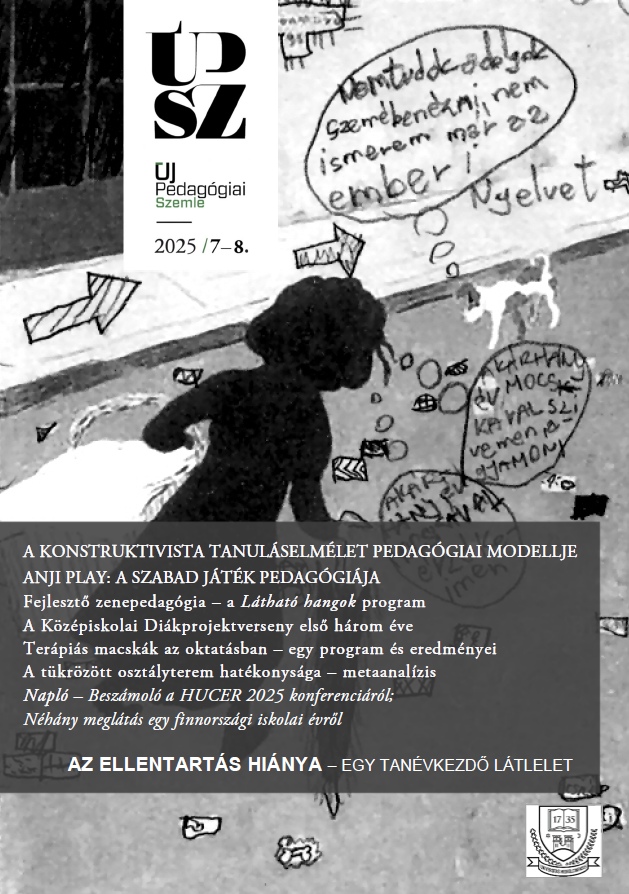
Vol. 75
(2025)
Issue 07-08 | DATE OF PUBLISHING: 2025-10-11 ABSTRACTS | 5-12 | [NÉV, NÉLKÜL] – ÚJ PEDAGÓGIAI, SZEMLE A perspective of a teacher starting over as a digital culture teacher in a big city in Hungary – about their experiences in an upper secondary school. The text contains edited excerpts from a two-hour conversation. |
| 13-34 | URBÁN, PÉTER This paper presents constructivist learning theory according to the theoretical and practical needs of pedagogy. This model is better distinguished from its epistemological and psychological links than in his earlier presenetations. We do not subscribe to the established practice of mechanically deriving methodological prescriptions from learning theory considerations. Instead, we want to focus on learning theory awareness, i.e. the attitude that makes it possible to evaluate instrumental (e.g. methodological) decisions or proposals in relation to a reflected concept of learning, a thought-out concept of knowledge and the specificities of the learning environment. It is necessary to introduce a new definition of constructivist learning theory: constructivist learning theory is a comprehensive pedagogical model of learning understood as the construction of knowledge by the student. After interpreting the components of this definition, the paper elaborates on this promising concept of learning theory, which can provide adequate answers to the most relevant problems of our time, by focusing on the concepts of meaning construction, expert knowledge, prior knowledge and the transitory nature of knowledge. The theory of learning is closely linked to the theory of knowledge at every point in the work, and the final chapter offers a new concept of knowledge based on the theory of learning. |
| 35-62 | BERTALAN, BEÁTA – PALKÓNÉ TABI, KATALIN This paper presents a specific form of children's free play pedagogy called Anji Play, a complex play pedagogical method developed in the Anji province of China, based on the experiences of an international kindergarten in Budapest. Around the world, more and more kindergartens are interested in Anji Play, but in Hungary this method is still little known, and therefore the literature on it in Hungarian is rather scarce. We would like to contribute to a wider awareness of Anji Play in Hungary among practitioners and theoreticians.
The method presented here was based on a qualitative field research in a kindergarten in Budapest, Hungary, with an international British pedagogical program, where the play of 73 children in 4 mixed-age groups was observed. In addition to observing the children’s play and notes of the teachers’ case discussions, we also collected data from the Kinteract online assessment system used in the kindergarten, and we conducted semi-structured interviews with eight teachers working in the kindergarten.
In our research, we sought answers to the following questions: 1. How does Anji Play pedagogy affect children’s skill development? and 2. What role does the preschool teacher play in the learning process mediated by play? Based on our observations, we can say that the defining elements of Anji Play pedagogy – the stepping back of the teacher, mutual trust, open-ended play tools, free, risky play, and reflection – enable the development of responsible, independent problem-solving and creative personalities. |
| 63-69 | VIRÁGNÉ JUHÁSZ-NYITÓ, KLÁRA The „Visible Sounds” program, associated with Ilona Antal Lundström, is a language and music communication program developed based on Kodály principles, focusing on sound-sign associations. The initial research findings linked to Mälardalen University in Sweden have confirmed the developmental impact of the program. The DIFER measurements from the 2026 studies in Hungary also reinforced the program's positive effects in both linguistic and musical abilities. Today, Hungarian-language educational materials for kindergartens and elementary schools are available for the program. However, few people are aware of it, and it is rarely applied in kindergarten and elementary school practices. This writing aims to present the possibilities and necessity of the program's integration and application in kindergarten teacher training. |
| 70-96 | PÁLVÖLGYI, LAJOS – MAGÓCS, ÉVA In our study, we review the experiences of the Secondary School Student Project Competition, which successfully debuted in the 2022/2023 school year, based on the mentor teacher and student questionnaires completed at the competitions. The introduction summarises the pedagogical relevance of student projects based on recent literature. In our view, an important factor in the effectiveness of student projects is that they replace school processes and relationships with workplace processes and relationships.
Our empirical research focused on how teachers and students perceive the positive and negative aspects of project work; whether they perceived project work and the project competition as a new challenge; and whether there was significant additional work for mentor teachers. The specificity of the competition is that teams compete and the theme of the value-added student projects can be chosen freely. A total of 154 teams competed in the first three seasons. The sample was not representative of the teachers and students involved (N=58, 99). Respondents were positive about the student projects, especially in terms of broad learning, experiential competence development and self-awareness. The competition presented a number of challenges for teachers and students, some of which arose from differences in the way the school operated and the projects were carried out. The article presents several related aspects and examples. The student project and the competition have created a noticeable extra workload for the mentor teachers, but they would strongly recommend their colleagues to participate with their students in next year's competition.
The paper concludes with a content overview of 15 typical student projects. The competition will continue to be organised in the future. Website: https://diakprojekt.hu/ |
| 97-113 | BÁNSZKY, NOÉMI – RUDOLF, PANKA The use of therapy animals in education is receiving increasing attention. This publication explores the possibilities of animal-assisted pedagogy, with a focus on the role of therapy cats in enhancing reading motivation. The authors present how therapy animals – especially cats – can support the reduction of anxiety, the improvement of attention focus, and the development of reading motivation through their calm presence. The paper includes both national and international experiences. The results so far suggest that animal-assisted reading sessions may not only increase students’ motivation to learn, but also contribute to the development of children’s self-confidence, empathy, and communication skills. |
| 114-131 | SIPKA, GERGŐ Thanks to technological advancements and evolving learner needs, the flipped classroom (FC) has become an increasingly widespread instructional approach. In this model, students acquire the foundational content independently—typically via video tutorials—before class. They then apply and reinforce these concepts during face to face sessions, primarily through active learning strategies. Numerous international studies have described and evaluated the FC’s implementation and effectiveness; however, most suffer from small sample sizes, limiting the generalizability of their findings. Meta analysis can address this limitation by synthesizing results across studies. In the present meta analysis, we reviewed 46 studies that met our inclusion criteria (high school context, pre /post test design, natural science subjects, flipped classroom implementation, and available measurement data). Our aim was to determine the magnitude of the FC’s effect on academic performance among 9th–12th grade students in the natural sciences. Consistent with international meta analytic findings, we identified a moderate positive effect (Cohen’s d = 0.609), indicating that the flipped classroom effectively enhances student achievement. |
| 132-134 | DARVAI, TIBOR The author's summary and brief evaluation of the 2025 HuCER Conference. It briefly discusses awards, traditions, proportions, and focuses. The evaluation of the sections focuses on the segment of educational history. |
| 135-138 | NAGY, ANNA The article describes a year spent at the Espoo School of Visual Arts (Espoon Kuvataidekoulu), Finland's largest educational institution for children and young people in the field of visual culture, as a teaching assistant. The institution aims to support students' visual arts skills, individuality, and spiritual development. The article focuses on the inspiring, student-centered educational approach that emphasizes community, creativity, responsibility, and sustainability. Beyond preserving visual culture and cultural heritage, the school uses the latest technologies to educate young people to become responsible, creative, visually literate citizens of the future. |
| |